
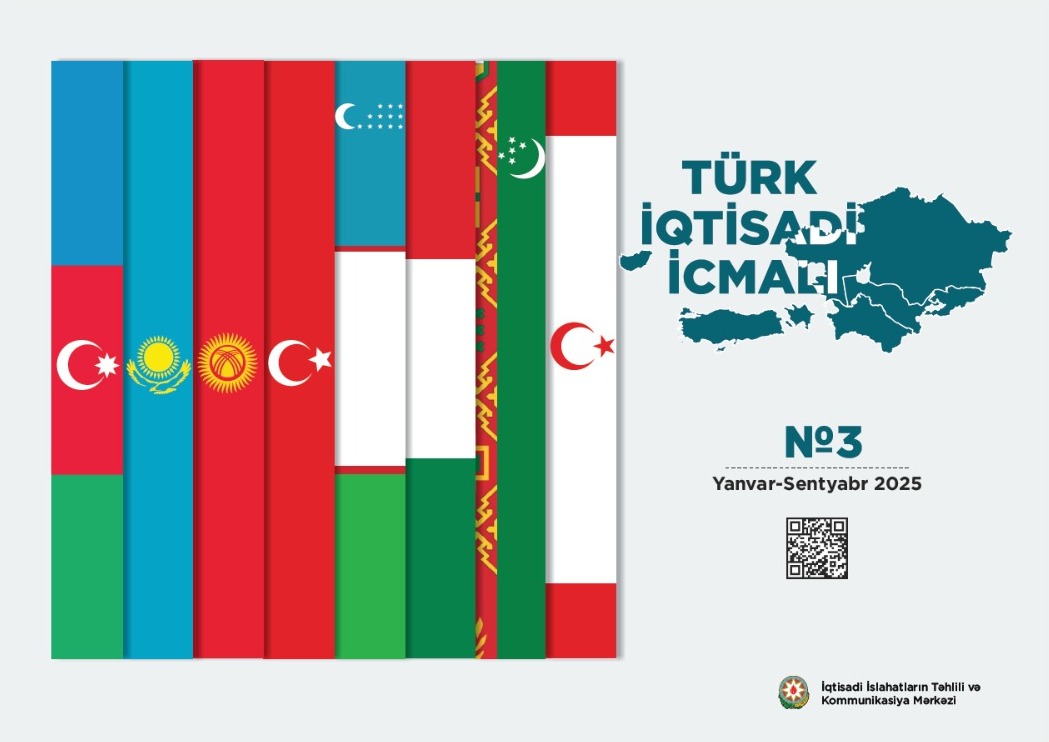
The latest edition of the “Turkish Economic Outlook” has been published
The edition of the “Turkish Economic Outlook” covering the period from January to September 2025 has been published. The report is jointly presented in eight languages by the Center for Analysis of Economic Reforms and Communication (CAERC) and the Secretariat of the Organization of Turkic States (OTS).
Startup.az reports that the study, prepared by the Turkic World Research Center operating under CAERC, provides a comprehensive assessment of macroeconomic dynamics, foreign trade, fiscal developments, and structural transformation trends in OTS member countries. During the first nine months of 2025, GDP growth across OTS countries amounted to approximately 6%, significantly exceeding the global economic growth rate of around 3%. Over the reporting period, the combined GDP of OTS countries reached $1.79 trillion, accounting for nearly 2% of global GDP. GDP growth was recorded at around 10% in Kyrgyzstan, 7.2% in Uzbekistan, 6.5% in Hungary, 6.4% in Northern Cyprus, and approximately 6.3% in both Kazakhstan and Turkmenistan. Economic growth in Türkiye stood at around 4%, while Azerbaijan recorded economic growth of 1.3%.
Foreign trade remains one of the key pillars of economic activity. In January–September 2025, the total trade turnover of OTS countries reached $958.5 billion, accounting for approximately 3.6% of global trade. This figure exceeds the region’s share in global GDP, reflecting the deep level of external integration of OTS economies. Energy-exporting countries maintained their trade surpluses. Azerbaijan’s trade surplus amounted to approximately $0.9 billion, while Kazakhstan recorded a surplus of $7.7 billion. Uzbekistan saw a significant increase in exports driven by industrial, agricultural, and processed products. Investment activity remained high across most countries in the region. Investments in fixed capital expanded due to large-scale infrastructure projects, transport and logistics initiatives, and energy projects. Financial intermediation capacity increased within the financial sector. In Türkiye, bank assets exceeded $1.05 trillion, while Kazakhstan and Uzbekistan recorded double-digit growth in bank assets. Investment flows were mainly concentrated in energy infrastructure, production capacity, logistics, and digital services.
Fiscal indicators were characterized by an expansion of the revenue base and persistently high nominal expenditures. In most member countries, state budget revenues increased due to economic growth, improvements in tax administration, and hydrocarbon revenues in energy-exporting countries. Expenditure growth was primarily associated with infrastructure development, social sectors, and strategic investments in green and digital transformation. Although fiscal positions varied across countries, overall budgetary policies were supportive of economic growth.
Progress in green and digital transformation has begun to translate into measurable economic outcomes, although results remain uneven across countries. Solar and wind energy projects, modernization of electricity grids, e-government platforms, digital tax administration, and smart infrastructure initiatives have expanded. Digital public services have contributed to improved fiscal efficiency, while green investments have supported long-term energy diversification objectives.
Transport and logistics connectivity has further strengthened as a structural growth factor. Cargo volumes along the Trans-Caspian East–West corridor have increased severalfold compared to the period before 2022, reinforcing the strategic role of OTS countries as a transit hub between Asia and Europe. Investments in ports, railways, border crossing points, and digital customs systems have increased transit flows and expanded the trade-related services sector.
Overall, data for January–September 2025 indicate that member countries of the Organization of Turkic States are growing faster than global averages, engaging in more intensive trade relative to their economic size, and allocating greater resources to investment, connectivity, and structural transformation. Progress in diversification, regional integration, and infrastructure development is expected to support economic growth rates in the coming periods.